
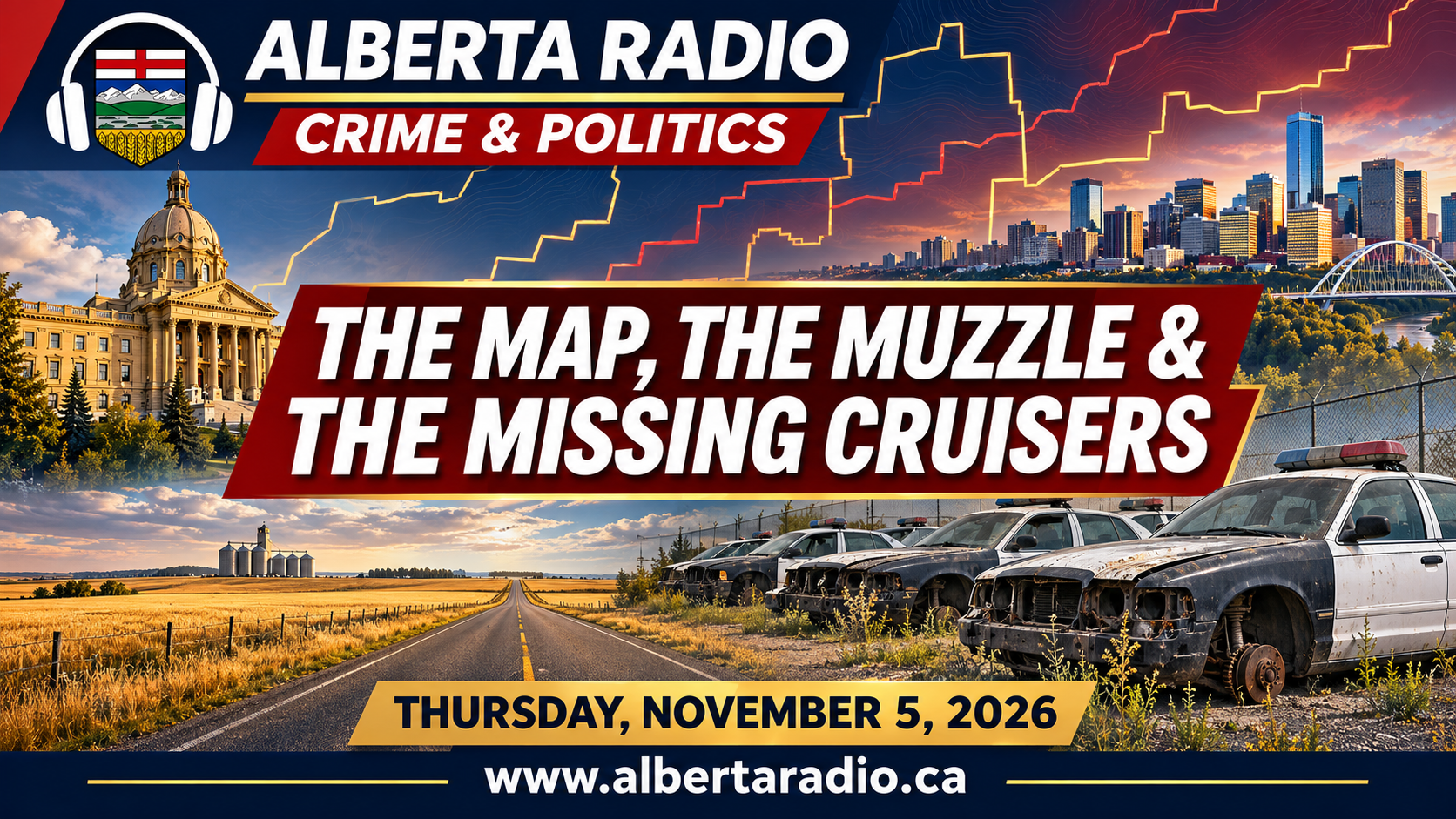
The Map, the Muzzle and the Missing Cruisers: A Week That Tells You Who Governs Alberta

Jason LaFace | Alberta Radio | Thursday, November 5, 2026
News analysis and opinion
Wednesday night, a little after six o’clock, Alberta’s legislature voted 45 to 36 to tell the government to write the province’s new electoral map into law, according to the supplied Os1ris briefing.
The vote split along party lines. Justice Minister Mickey Amery’s motion asked MLAs to concur in the proposals of the redrawn map published Monday and bring forward legislation to make it official. The motion is a step toward new boundaries; it does not itself put the final boundary legislation into force.
The Opposition NDP had a word ready: rigged. Naheed Nenshi calls the map a gerrymander, wants a return to the original commission’s maps and says his party will challenge the new boundaries in court.
Before Albertans swallow that line whole, it is worth slowing down and asking what the map actually does, whom it serves and what else happened in this province while the political argument filled the headlines.
What the map does
The new proposal adds four seats, taking the legislature from 87 to 91. A five-member advisory panel produced it after the government rejected the earlier Electoral Boundaries Commission report. The majority included two UCP appointees and a retired judge appointed through a legislature committee. The two Opposition members dissented.
That distinction matters: this was a replacement advisory process, and Albertans should judge both its mandate and its recommendations rather than treating every boundary exercise as interchangeable.
Lethbridge draws the most attention. The city would go from two urban ridings to one wholly urban seat and three ridings combining city neighbourhoods with surrounding rural areas. West Calgary would also see more urban-rural combinations.
The NDP argues that adding rural voters to urban districts benefits the UCP and dilutes city representation. Amery’s defence is that hybrid ridings already exist and can unite communities sharing services, employment, infrastructure and economic interests.
Anyone who has lived in southern Alberta knows that argument has substance. People outside Lethbridge buy parts, seek medical care, work and do business in the city. A municipal boundary does not sever those relationships.
Does it actually tilt the province?
The supplied briefing cites a Globe and Mail analysis finding that, when recent election results are applied to the proposed boundaries, the overall partisan shift is more modest than some expected. It also notes advantages for the UCP in parts of northwest Calgary and Lethbridge.
That is a reason to examine the numbers riding by riding. It is not enough to jump straight from an advantage in particular districts to declaring an election stolen.
My view is that the NDP’s preferred map deserves the same scrutiny as the government’s. Opposition parties have electoral interests too. Albertans should demand evidence about representation, geography and population rather than accepting either side’s slogans.
A modest projected province-wide effect would not, by itself, settle whether individual boundaries are fair. That is why the government needs to explain the local choices clearly.
The rural voice is the real question
Rural concerns deserve more attention than the partisan shouting. At the Rural Municipalities of Alberta convention, some leaders warned that a hybrid riding could leave county residents represented by an MLA focused mainly on its urban population.
That is a legitimate worry. Rural Albertans grow food, produce energy and sustain communities spread over enormous distances. Rapid population growth in Edmonton and Calgary makes the question of effective representation more pressing.
A conservative government should make sure distance from the legislature does not mean distance from political influence. But protecting rural voices takes more than drawing a line around a city and a county.
Here is my test for the legislation: does each hybrid riding share a coherent economy, service network and community of interest? Can residents reach their MLA and receive meaningful representation? If the government can answer those questions, it has a defensible case. If it cannot, criticism deserves a serious hearing.
A free-speech promise followed by a retreat
The free-speech story should concern conservatives at least as much as the map. Reporting carried by the Edmonton Journal, citing The Watchdog, describes Premier Danielle Smith telling a Rebel Media event on Saturday that she was discussing prioritizing repeal of section 3 of the Alberta Human Rights Act with Amery.
Section 3 addresses discriminatory publications and displays on protected grounds. It also contains an express protection for the free expression of opinion. Critics argue that its wording can chill lawful speech; that argument should be considered alongside the law’s purpose and its interpretation by courts and tribunals.
By Tuesday, Amery was describing an ongoing assessment of legislation against Charter protections. His office then said: “We are not contemplating any changes to the Alberta Human Rights Act.”
Those messages do not line up comfortably. I do not know which reflects the government’s settled intention, and supporters deserve a clear answer.
If the government believes section 3 is sound and worth retaining, it should defend that position plainly. If it believes the provision chills lawful speech, it should explain what it intends to change. Promising movement to a friendly audience and then denying plans days later damages trust.
Where the government is getting it right
Bill 38, the Advanced Education Statutes Amendment Act, 2026, would require institutional neutrality policies for post-secondary schools while preserving the individual expression of students, faculty and staff. The proposed neutrality requirements concern institutional positions outside the academic mission.
That is the right distinction. University administrations should make room for argument rather than instructing every dissenting student or junior professor which political position the institution expects.
The province also proposes limiting tuition increases for existing domestic students to two per cent in 2027–28 during the transition, through future regulatory changes. Families will want to see the final rules.
Bill 39, the Health Statutes Amendment Act, 2026 (No. 2), would clarify public funding for community laboratory services. Private clinics would be responsible for lab costs associated with uninsured services, while publicly funded access for insured, physician-referred care would continue.
The supplied briefing cites reporting that public funding of some private lab work has cost about $12 million a year. The principle is straightforward: people may choose private services, but the funding rules should clearly identify who pays. The proposal deserves scrutiny and credit for addressing that distinction; its effect will depend on passage and implementation.
The missing cruisers
Alberta RCMP allege a criminal network diverted hundreds of decommissioned police vehicles intended for destruction. GC Surplus had contracted Edmonton’s Penny Metal Recycling to destroy 950 vehicles beginning in spring 2025.
Police say vehicles were obtained under false pretences, given new identification numbers and resold in Canada or exported. Investigators also linked the network to more than 80 other stolen or illegally exported vehicles valued at about $6 million.
A warehouse search produced more than four million illegal cigarettes, police say, valued at $3.7 million. Five men, four from Edmonton and one from St. Albert, face charges. One accused worked at the recycler. The company has been listed as an ineligible and suspended federal supplier since April.
The person police describe as a major driver of the operation died before charges could be laid against him. Investigators say others involved remain unarrested. The allegations against the accused have not been tested in court.
The case raises serious questions about verification under federal disposal contracts. If vehicles were certified as destroyed but instead sold, taxpayers deserve to know how that happened and what controls will prevent it happening again.
RCMP also link the alleged network’s activity to harm across Alberta’s vehicle market. That does not establish how much any individual insurance bill changed, but it underlines why organized auto theft deserves sustained attention.
The rest of the crime file
Edmonton police say a cellphone scam connected to call centres in Lahore, Pakistan, has caused roughly $20 million in local losses. Callers impersonated telecommunications providers, offered attractive deals and persuaded victims to send legitimately ordered devices to other addresses.
A 31-year-old faces fraud, trafficking-in-stolen-property and forgery-equipment charges. EPS says information shared internationally helped disrupt suspected call centres. The charges remain unproven. If an unsolicited caller offers a phone deal, contact your provider through a trusted number before sending personal information or a device.
The Os1ris briefing also reports nine people charged across three Maskwacis-area drug investigations, with seizures including cocaine, methamphetamine, oxycodone, a sawed-off shotgun and more than $362,000 in cash. It says one supply investigation led back to Edmonton. These are police allegations, not findings of guilt.
In Calgary, the briefing reports additional allegations against a 33-year-old already accused of human trafficking, including alleged attempts to pressure complainants not to cooperate with prosecutors. The allegations have not been proven.
In Fort McMurray, ALERT announced a cocaine investigation in which officers seized 420 grams of cocaine and nearly $27,000. Charges were laid following a Lower Townsite search, and a warrant was issued for a second 19-year-old Edmonton suspect. The announcement was this week; the charges date to September 24.
Calgary’s Operation Order combines visible enforcement with referrals to support services. The briefing’s November 4 figures were preliminary and used overlapping charge descriptions, so they should not be read as a final operational tally.
Calgarians will judge the program by sustained safety in downtown streets, transit spaces and businesses, alongside whether vulnerable people receive effective help. A day’s activity count is only part of that picture.
Edmonton police also say the proposed four-year capital budget leaves approximately $61.66 million of their request unfunded. Their request covers technology, communications and infrastructure, with approximately $121 million recommended against a request of roughly $183 million.
There is a proper debate to have about police spending and accountability. But sophisticated fraud and organized vehicle theft make reliable investigative systems and communications a practical issue, not just a budget line.
What ties it together
Alberta is growing, political expectations are shifting and organized crime creates real costs for families and businesses. People want a government that knows what it believes, explains its decisions and delivers on its promises.
On the map, the UCP has an argument worth making. Hybrid ridings can reflect the way Albertans live and work. The government should defend every boundary with evidence, and its critics should do the same.
On campuses, the distinction between institutional neutrality and individual freedom is sensible. On public funding of private services, clear rules are overdue.
On free speech, however, supporters deserve consistency. A government cannot build trust if its weekend message and weekday message point in different directions.
Draw the map carefully. Defend it riding by riding. Explain the legislation before asking people to trust it. And do not make promises on Saturday that you are not prepared to stand behind on Tuesday. The next scheduled election is less than a year away.
— Jason LaFace, Alberta Radio
Source: Os1ris News Aggregation, with supporting reports linked below.
Supporting reports
Support Alberta Radio
Help cover Alberta Radio’s broadcasting, hosting and local coverage costs with a $50 donation. Thank you for supporting independent Alberta voices. Send news tips and public service announcements to jason@albertaradio.ca. Listen 24/7 at www.albertaradio.ca.


